Winter hiking: the gear you need
- Difficulty: Any level
- Duration: From 1 day
- Season: Winter
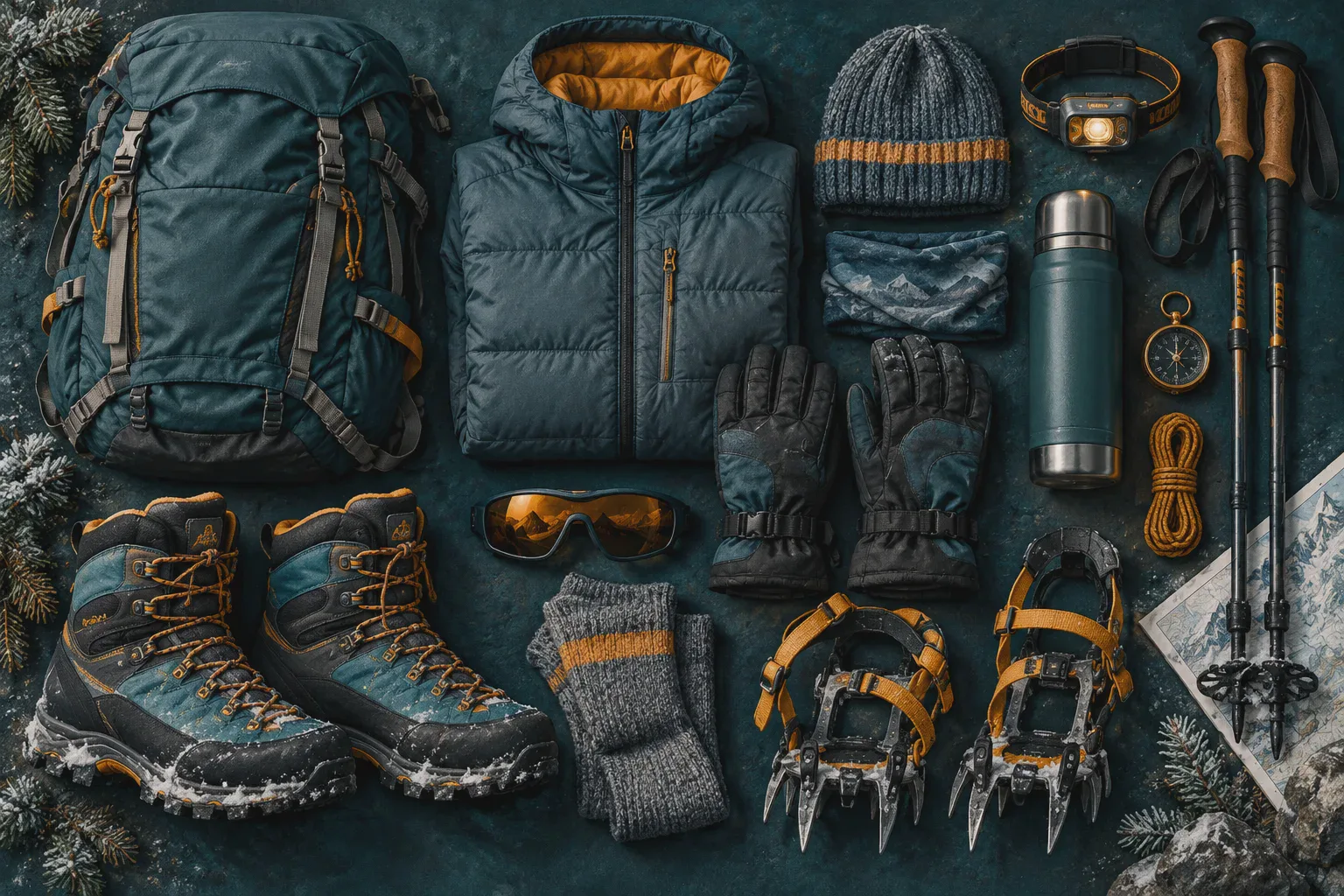
In winter the mountains around Bishkek and Issyk-Kul become quieter, cleaner and more beautiful — but also stricter. In December daylight lasts only about nine hours, in the gorges of Ala-Archa it easily drops to −15…−20 °C by evening, and a single soaked layer of clothing can spoil the whole day. The good news: a properly packed backpack takes care of most of these risks. Below is the list we use on our own winter outings.
Clothing: the three-layer system
The main rule of winter isn't to "dress warmer" but to dress in layers, so you can take off and add warmth as you go. On the climb you sweat; at a rest stop you cool down instantly.
- Base layer — merino wool or synthetic thermal underwear. No cotton: it soaks up sweat and stops keeping you warm.
- Insulating layer — a fleece or a light synthetic jacket (Primaloft and similar).
- Shell layer — a membrane jacket and trousers that keep out wind and snow.
- A down jacket for breaks — a warm jacket you put on over everything at stops and on the summit.
- A hat, a buff or balaclava, two pairs of gloves (thin ones for walking and warm mittens), spare socks in a waterproof bag.
Footwear and everything on your feet
- Boots — warm trekking boots with a membrane and a stiff sole, broken in beforehand. For high-altitude routes — winter mountaineering boots.
- Gaiters — keep snow out of your boots in deep snow.
- Microspikes — for trodden, icy trails such as the paths to waterfalls; they go on in a minute.
- Crampons — for steep firn and ice slopes. Check that they fit your boots.
- Snowshoes — if the trail isn't broken and the snow is deeper than your knees. Without them you'll sink to your waist in untracked snow.
- Trekking poles with wide "winter" baskets.
Safety
If the route crosses avalanche-prone slopes (and that's most gorges above 2,500 m), every member must carry an avalanche kit, and the group must know how to use it:
- an avalanche transceiver (beacon) switched to transmit from the start of the route;
- an avalanche shovel;
- an avalanche probe.
A kit without practice is useless: a buried person has to be found and dug out within 15 minutes. Practise a search at least once before the season.
- A headlamp with spare batteries — even for a day trip. Keep the batteries in an inside pocket: they drain quickly in the cold.
- Sunglasses of category 3–4 and SPF 50 cream: snow reflects up to 80% of UV, and snow blindness is a real risk.
- A first-aid kit: painkillers, bandages, blister plasters, an emergency blanket, chemical warmers.
- A charged phone kept warm, a power bank, an offline map of the route. The emergency number in Kyrgyzstan is 112.
Food, water and warmth
- A thermos of hot sweet tea — better than a bottle that will freeze by lunchtime.
- High-calorie snacks that don't turn rock-hard in the cold: nuts, dried fruit, chocolate, kurut.
- For a multi-day trip — an isobutane/propane gas mix (pure butane won't burn in frost), a sleeping bag rated for comfort to −15 °C and a mat with a high R-value.
Before you set out
Tell the people staying below your route and return time. Check the weather forecast and the avalanche situation, and don't go on difficult routes alone. We've put the checklist from this article into a PDF — print it and tick things off as you pack your bag.
📄 Download the PDF (in Russian): Winter hiking: the gear you need